


Lessons in Loss: The Hip-Hop Community
- Emily Day
- Jan 23, 2019
- 6 min read
Updated: Sep 22, 2020
The following was published in A Magazine Vol. 7
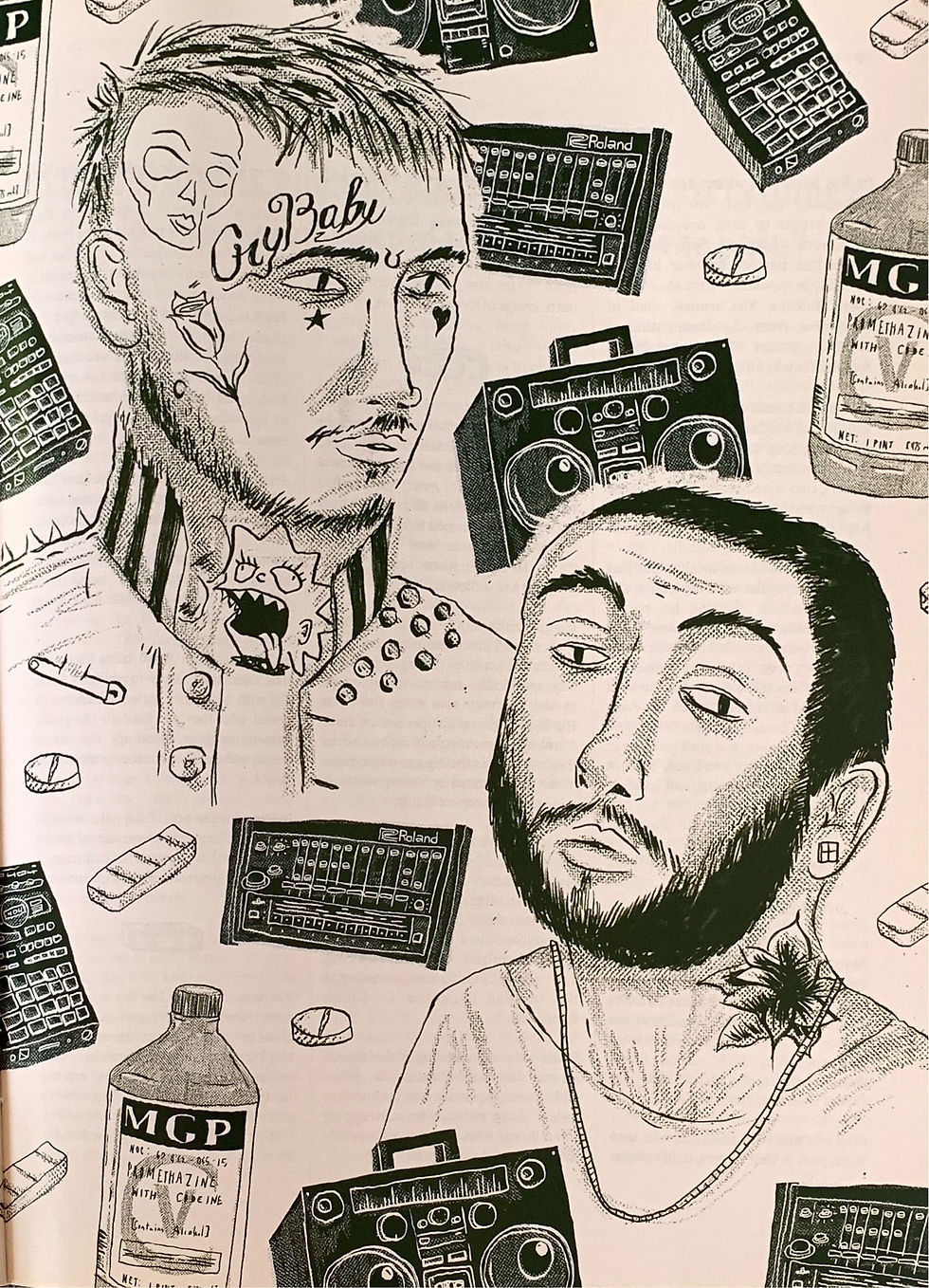
In the past year alone, the hip-hop community has lost two prominent young artists to drug overdose. Lil Peep, born Gustav Åhr, overdosed on Xanax just two weeks after his 21st birthday in November 2017. Mac Miller, born Malcolm McCormick, died in September from a lethal combination of cocaine, ethanol and fentanyl.
McCormick signed with Rostrum Records in 2010 and Åhr had just released his first mixtape in 2015. Although the two were at different points in their respective music careers, they were bound together by one thing: their openness about their drug habits and, as a result, their tragic deaths.
McCormick had been vocal in the past about his struggles with depression and bipolar disorder, claiming his mental illnesses to be the reason he abused drugs. He previously stated that he “hated being sober,” but never considered himself an addict. When asked about the threat of overdose in an interview with the Fader in 2016, McCormick’s answer, “There’s no legendary romance, you don’t go down in history because you overdosed. You just die,” is now just as haunting as it is sad.
Åhr’s first album, “Come Over When You’re Sober, Part 1,” was a preview into the rapper’s mind as he spoke of topics such as substance abuse, loneliness and suicide. He, too, was often candid about his experiences with mental illness, though he never appeared to receive any type of treatment for his ailments.
Why is it that both musicians who were at the peak in their careers didn’t receive successful treatment for their addictions? Here we had two young men who were open about their illnesses in their music and in interviews during their careers, but the warning signs became eminent far too late, followed by the outpourings of love and support.
Ozie Ikuenobe, otherwise known by his stage name, Intellect, is a Kent-based hip hop artist and longtime fan of McCormick. He, like most, was stunned to hear the news of the 26-year-old’s passing. “He always seemed to speak through his music when he was dealing with things. He definitely was open about his drug use and addiction,” Ikuenobe says.
Mental health in any context should be spoken about more frequently and openly, but mental health in the hip-hop community, specifically, deserves to be brought to the forefront now more than ever. Hip-hop makes up 25.1 percent of music consumption, beating out Rock music for the first time as the biggest music genre in the U.S. according to Nielsen Holdings’ mid-year music report in July.
The vast majority of hip-hop musicians are male, and the same goes for their male-dominated as found by Spotify Fan Insights. Substance abuse and addiction, sometimes called “slow-motion suicide,” is a predominately male disease. In fact, as of 2016, males make up every 7 out of 10 suicide victims as stated by the American Foundation for Suicide Prevention.
When someone is dealing with a mental illness, they can be vulnerable. When adding young age into the factor, you now have a young person who is struggling mentally and relies heavily on the people they admire to help them feel better.
One in five people in the U.S. deal with mental illness each year according to the National Alliance on Mental Illness. Black Americans are 20 percent more likely to be suffering from mental illness, but half as likely to receive treatment compared to white Americans. Hip-hop is a primarily black industry, and the phrase- “hip-hop is my therapy”- has been overused by musicians for decades as an easy way of avoiding real, constructive therapy. This could be due to economic factors or blatant cynicism for the health care system.
Artists like Kid Cudi and Logic have been trailblazers for starting the conversation about mental health. Cudi announced in 2016 that he had gone to rehab for depression and suicidal thoughts. Logic’s hit single “1-800-273-8255” came out in partnership with the National Suicide Prevention Lifeline.
Dr. Siri Sat Nam Singh hosts Viceland’s “The Therapist,” a show in which Dr. Singh sits with musicians, including rappers, to reveal who they are beneath the public persona and to encourage the act of simply talking to someone, professionals or not.
In October, Chance the Rapper donated $1 million dollars to improve mental health services in his hometown of Chicago, a city that is 33 percent African-American.
“The way music and hip-hop is nowadays, everything’s a lot more open minded than it was in the past,” Ikuenobe says. “I think as a lot more views and mindsets became accepted around the world, hip-hop started to reflect that. It’s always been a genre that’s open to change but I think that’s really been proven in the last few years.”
The stigma still exists though, and not just in music, but in our culture as a whole. The fear of being labelled and rejected is a common fear for people suffering with a mental illness, and can often keep them from reaching out for help. Labeling can trigger powerful expectations of rejection that will ultimately erode confidence, disrupt social interaction and impair both social and occupational functioning the American Sociological Association says.
Angela Neal-Barnett is an award winning psychologist, an author and a professor at Kent State University. She is also director of the Program for Research on Anxiety Disorders among African Americans (PRADAA) which strives to “make a difference in the lives of African Americans.”
“Anxiety is the most common mental health disorder in the United States and impacts African-Americans at a higher rate than any other group…,” Neal-Barnett tells NBC. She says for many African-Americans experiencing anxiety, factors such as family or religious beliefs may encourage them to downplay their symptoms as just nerves.
“We are taught that anxiety is the result of something we are doing wrong. If we pray a little harder, if we keep ourselves in the world more we would not be experiencing this,” she says. Neal-Barnett encourages people dealing with anxiety to “call it what it is” in order to accept it and figure out how to manage it. Above all else, find the courage to ask for help. Anxiety is not permanent. As Neal-Barnett states, “It is treatable and you can reclaim your life.”
When it comes to the issue of drug use, hip-hop isn’t entirely to blame. Music is and always has been a mirror of the culture that it’s in. References to cocaine were abundant in hip hop during the ‘80s and early ‘90s due to the big cocaine pandemic in the U.S. The new reality of today’s culture is that drugs, opioids specifically, are way too accessible.
In 2017, the U.S. Department of Health and Human Services declared a nationwide public health emergency concerning the opioid crisis. According to the Center for Disease Control, 91 Americans die of opioid-related overdose each day. Because of its rapid growth in popularity, many opioid abusers haven’t been properly educated on the life-threatening consequences that come with taking these drugs. The only difference from 20 years ago is that addicts today can receive much better overall treatment, overdose-reversing medications and can take part hospital detox programs, rather than simply being placed in a jail cell.
Counterfeit pills that are shipped into the country from China and Mexico are growing in popularity at a fast rate. These pills typically contain fentanyl, a painkiller that’s between 50-100 times more potent than morphine. The favored substance is fentanyl-laced Xanax, the lethal combination responsible for Åhr’s passing.
Anne Scuchat, director of the Center for Disease Control, tells WKMS, “We think that the number of people addicted to opioids is relatively stable. But the substances are more dangerous than five years ago.” Opioid-related hospitalization has risen to great heights in only the past few years, according to the CDC.
According to the American Society of Anesthesiologists, 30 percent of people between the ages of 18 and 36 believed it was OK to use opioids without prescriptions. An alarming number of millennials are self-medicating to cope with the enormous stress of an increasingly competitive workforce and financial struggles.
This can stem from instances of overwhelmed college students taking Adderall to pull all-nighters or someone who suffers from social anxiety relying on alcohol to cope with social situations.
Overdoses by synthetic substances like fentanyl, oxycodone and codeine killed more people in 2016 than gun-related violence and car accidents. Death from opioid abuse increased by 540 percent in only three years.
If there’s one thing to blame for this- its stigma. The stigma around mental illness and the stigma around addiction. Both are deadly diseases that very few people seem to want to talk about for fear of being placed into a separate corner of society.
So, rather than typing out our words of love and support next time we lose a prominent pop culture figure to overdose or suicide, let’s work tirelessly to demolish the stigma and to encourage the conversation on mental health and the effects of substance abuse.
Let’s do it not just for your favorite musicians, but for your family, friends, co-workers and everyone in your community who might be in a place where they so badly need it.
Words by: Emily Day
Art by: Peter Kratcoski


Comments